

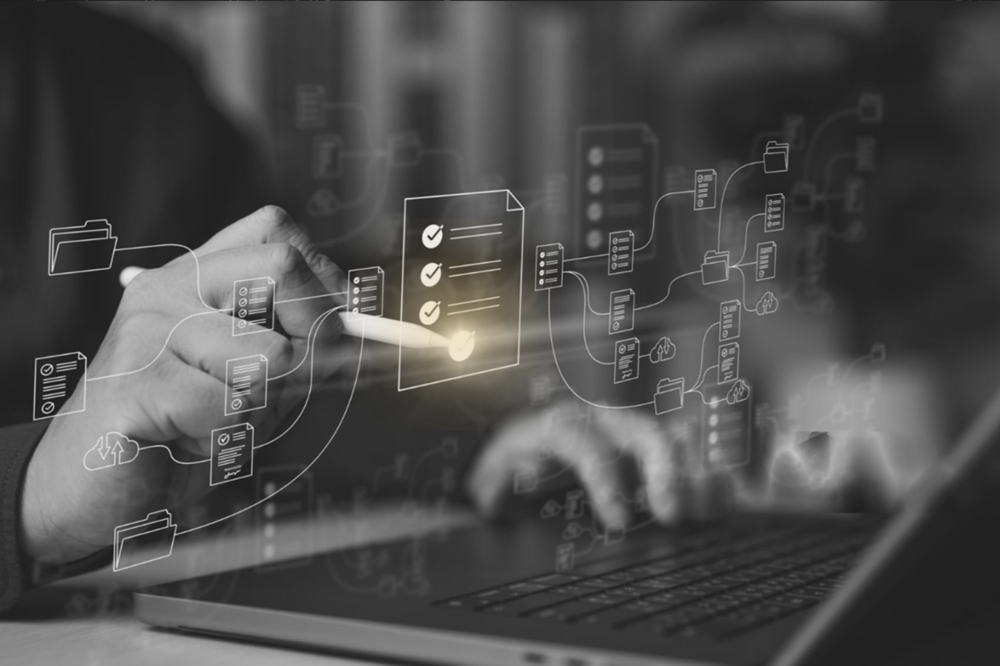
Contextual guidance reduces obstacles in digital workflows by providing in-context, real-time, in-app support that simplifies complex tasks and motivates users to complete a task as quickly as possible. WalkMe is an example of this form of working with technology that allows tasks to feel more intuitive and natural.
Instead of asking employees to pick the software up with either manuals or structured training time, WalkMe builds the guidance right into the software interface. Users know what to do, when to do it, and receive visual cues and smart prompts to help them. As you can imagine, this timely assistance reduces pauses, reduces errors, and ultimately allows employees to operate with more confidence.
Contextual guidance removes unnecessary steps and uncertainty in workflows so the employee simply completes the workflow without wasted time figuring out how or the steps involved. WalkMe allows for a digital experience that transforms it from a maze to a map and makes every task feel intuitive and frictionless.
Digital Workflow Friction in Modern Enterprises
Digital friction happens when employees encounter hurdles or a lack of efficiency using business applications. It is often fueled by complicated or confusing designs, inconsistent systems, or lack of support. WalkMe solves these issues by simplifying the employee journey.
The most common causes of workflow friction are:
- Poorly designed or unintuitive software, and navigation.
- Manual data entry or duplicate steps.
- Lack of customized or real time support.
- Long learning curve for new employees.
When these scenarios continue, productivity goes down, frustration increases, and adoption rates drop. WalkMe provides contextual guidance and eliminates pain points by having supportive prompts in every workflow. Employees do not have to leave their work to seek assistance, it comes to them.
This adaptive support system reduces cognitive demand and yields better, easier workflow completion. The result is an environment where digital workflows flow from start to finish.
The Role of WalkMe in Delivering Seamless Employee Digital Experience
WalkMe improves the employee digital experience by harmonizing the usability of software applications and the behavior of people. It anticipates a user’s needs and offers intelligent guidance that enhances transitions in workflow to minimize confusion and downtime.
Through automation, personalizations, and real-time, in-app interactions, WalkMe turns complex systems into intuitive workspaces. Employees now receive contextual prompts and walk-throughs of exactly what to do next, while staying in the application.
This translates into multiple improvements, including:
- Reduced training and onboarding time.
- Increased confidence in engaging with enterprise tools.
- Greater consistency in task completion.
- Reduced errors in critical business workflows.
The employee digital experience improves when the software behaves like a quality partner instead of a potential hazard. WalkMe cultivates that partnership by emphasizing guidance combined with usability, enabling organizations to convert digital adoption into a daily milestone.
In-App Guidance for Turning Confusion into Confidence
The in-app guidance provided by WalkMe is the solution to removing uncertainty from digital workflows. Users, instead of turning to outside resources, receive support while they are performing tasks. Learning becomes immediate and actionable.
WalkMe’s in-app products provide guiding users through each process, step by step. Tooltips, checklists, and notifications about progress keep the employee engaged and on track.
This “real-time” approach results in:
- Higher rates of task completion.
- Less reliance on IT for support.
- Improved accuracy and compliance.
- Greater user confidence in using systems.
By embedding the learning into the workflow, WalkMe can make sure that employees do not experience lost motion. Learners learn by doing and each transaction is profitable for both speed and certainty.
Contextual Learning Tools for Instant and Personalized Support
Adaptive learning resources align with the user’s job role, skill level, and work activities, delivering exactly the information needed in that moment. WalkMe utilizes adaptive learning tools in order to ensure every user gets the right guidance at the right time.
These adaptive learning tools act with intelligence and detect when users are facing a challenge and provide timely assistance through:
- Pop-ups that deliver task-specific instructions or definitions.
- Guided paths triggered by specific user actions.
- Reminders to finish workflows or open approvals.
- Updated learning content in response to organizational change.
Targeted tutoring transforms the digital ecosystem into a personalized tutor. It bypasses trial-and-error learning, helping workers get skilled quicker. The more employees engage, the smarter the system becomes and the more efficient the guidance; increasingly reflective of real-world use. That’s how WalkMe ensures learning is contextual, seamless, and instant.
User Productivity Enhancement through Guided Digital Workflows
Digitally guided workflows support workforce focus towards achieving outcomes rather than on how to navigate through them. WalkMe creates digital workflows to lead users through each discrete task without delays and to help maintain standards of quality across teams.
Workplace employees are supported by workflows that are well defined and easily followed which also align to organizational processes. The outcomes are:
- Onboarding is faster and time to productivity decreases.
- Approvals, reporting and other horizontal processes are streamlined.
- Cross-department collaboration is enhanced.
- Operations are subject to fewer errors and process bottlenecks.
WalkMe connects every action to a meaningful goal that will allow employees to perform the task with greater confidence and more accuracy. This results in productivity increases for all workers in the activity – WalkMe effectively takes the pieces of digitalized processes that dispense and creates a single cumulative workflow ecosystem that is productive.
Key Benefits of Contextual Guidance in Workflow Optimization
Contextual guidance does not merely make processes easier – it makes them better. It allows workers to get on with their job, while the system responds in real time with advice, direction and corrective help.
WalkMe’s contextual capabilities provide a number of measurable, positive outcomes:
- Substantial reduction in software frustration.
- Greater digital adoption and task completion.
- Reduced reliance on help desk and training.
- More compliance to policies.
- Greater engagement and satisfaction.
With each instance of an employee receiving relevant, timely support, friction dissipates. WalkMe turns fragmented processes into fluid experiences, advancing productivity and clarity in tandem. This reinvigorating feedback loop supports companies’ ongoing operational improvement and digital readiness.
Building a Frictionless Digital Culture with WalkMe
Establishing a frictionless digital culture refers to leveraging technology that adapts to people, not the other way around. WalkMe does this by seamlessly embedding guidance in context at every step of the digital journey, making digital work feel easy, natural, and intuitive.
When employees trust their digital tools, they are more open to change and adopt new systems faster. WalkMe’s data-driven insights help organizations to pinpoint where employees are struggling, making it much easier to update guidance and optimize workflows.
In order to sustain this frictionless culture, organizations must:
- Continue to monitor user behavior through WalkMe analytics.
- Update the guidance based on your changing processes.
- Encourage employees to offer feedback to continuously improve the workflow.
- Reward team members for being digital self-sufficient.
Over time, WalkMe develops a work environment of freedom and clarity. This is the work environment where friction is replaced by flow and where every workflow is an opportunity for continuous improvement.
Sustaining Long-Term Efficiency with Continuous Contextual Guidance
Continuously sustaining efficiency is more than just a matter of training, it is about providing assistance on a continuous basis. WalkMe’s contextual guidance provides ongoing, continuous contextual support, so employees can always be productive when things (the systems) change or new systems are introduced. The content, including prompts, walkthroughs, and learning paths, were automatically updated with the process of use, so employees remain supported regardless of changes that occur in work and in systems.
By providing contextually relevant, continuous, and consistent support, productivity dips are interrupted with software updates and updates in process improvements. Employees feel confident, knowing they will have the proper information at their fingertips when they need it. Over time, this ongoing responsiveness establishes and grows digital confidence while reducing the potential of employees having to relearn a new process multiple times.
WalkMe creates self-correcting environments where other learning never stops and where friction never builds up.
Sustained efficiency, quicker adoption of new systems, and a workforce that feels supported through every stage of Digi-transfer means that one could conclude that contextual guidance is not only a feature but an essential strategy for long-lasting digital success.
FAQs
Author Bio

Rupal Agarwal
Chief Strategy Officer
Dr. Rupal’s “Everything is possible” attitude helps achieve the impossible. Dr. Rupal Agarwal has worked with 300+ companies from various sectors, since 2012, to custom-build SOPs, push their limits and improve performance efficiency. Rupal & her team have remarkable success stories of helping companies scale 10X with business process standardization.
