

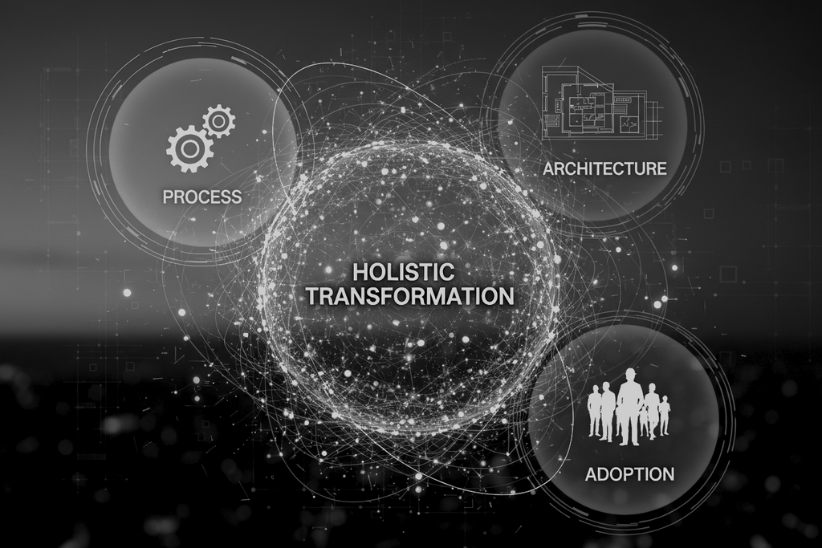
Holistic transformation connects your organization’s business processes, IT architecture, and user adoption plans into one cohesive strategy. When business processes, IT architecture, and user adoption plans are working together, companies experience faster ROI, reduce risks, and can start to see results in a measurable and tangible way. Many times transformation initiatives can fail not because the technology was inadequate, but because the processes, systems, and user bad habits were disconnected.
By looking at business process optimizations, a solid IT architecture, and an emphasis on user adoption, companies can provide their employees a seamless transformation experience.
Some tools such as Signavio collaboration tools, LeanIX business capabilities maps, and WalkMe provide a simpler way to align the three pillars of transformation, so that improvements on paper can begin to have an effect in reality. Holistic transformation is not just a jargon term, it is the future of transformation and the only path for sustained change.
Understanding Holistic Transformation
When we talk about holistic transformation, we are not just talking about enhancing systems and digitizing processes; It requires a complete re-imagining of how the organization carries out its business. It is about understanding that business processes, IT architecture, and end-user adoption are interdependent parts of a single ecosystem.
Key tenets of a holistic transformation include:
- Process clarity: Making sure that workflows are clear and optimized.
- Architecture alignment: Making IT systems responsive to the business needs, including ways of working and priorities of the overall organization.
- Adoption focus: Focusing on driving user engagement and skills based on new technologies identified thereby ensuring information flows.
A holistic transformation goes beyond the traditional siloed initiative approach or, in other words, creates one vision where processes are synchronized with data and the corresponding user behavior, and the relational value provides mitigation for duplication, cost reduction, and how to achieve business goals at speed. CIOs and transformation leaders are increasingly recognizing that achieving the desired outcomes requires a combination of these three pillars and not taking these areas separately.
The Role of Processes in Holistic Transformation (Signavio Collaboration Tools)
Business processes are the key that unlocks transformation. They describe how work flows across people, departments, and systems. Tools like Signavio collaboration tools and Signavio governance workflows allow organizations to map, analyze and optimize their business processes at scale.
Some key advantages of focusing on processes include:
- Consistency: Unified and standardized workflows diminish opportunities for error and misuse.
- Visibility: Teams have greater awareness of how their activities connect across functional boundaries of the organization.
- Compliance: Governance workflows enable organizations to ensure adherence to established guidelines and the regulatory framework.
By leveraging the entirety of Signavio’s tools, organizations can:
- Create unified process models that drive better collaboration and relation between teams.
- Use governance workflows in a change management capacity.
- Connect processes to performance metrics and make decisions based on relevant data.
By getting processes correctly, businesses give their architecture and execution strategies the best opportunity to succeed in the long-term.
The Role of Architecture in Holistic Transformation (LeanIX Business Capability Maps)
Technology architecture provides the foundational technology for transformation. Without a technology architecture, even the best processes will not yield outcomes. LeanIX business capability maps and LeanIX transformation hub allow for a full understanding of the systems that are supporting which capabilities.
Benefits of being architecture-centric:
- Visualizations: You can see your entire IT ecosystm.
- Scalability: You can plan to grow without interrupting your business.
- Optimization: You can see duplications and save money.
Across each of LeanIX’s platforms, organizations can:
- Align their IT systems with strategic business objectives.
- Understand the interdependencies between applications, data, and workflows.
- Develop roadmaps for modernization and migration projects.
By being intentional with IT architecture, leaders can position their maturity via transformation into sustainable and future-proof practices.
The Role of Adoption in Holistic Transformation (WalkMe Process Guidance)
Without solid user adoption, even the best processes and architecture will fail. Employees cannot know they need to adopt new systems, and you must provide them guidance, instruction, and support if you want to take full advantage of the changes in the organization. This is where WalkMe process guidance also comes in. WalkMe provides in-app guidance, step-by-step process guidance, and interactive learning.
Why is adoption important?
- User comfort: Employees will have confidence in using new tools.
- Reduced training expenditure: In-app guidance saves on the costs of classroom training.
- Time-to-value: Employees are up and productive very quickly.
WalkMe can help organizations:
- Automate onboarding for new software.
- Provide context supported help for employees.
- Collect user metrics for adoption for ongoing improvement.
By focusing on adoption in conjunction with process and architecture, you can realize the benefits of transformation.
Benefits of Combining Process, Architecture, and Adoption
When process, architecture, and adoption are combined, transformation anchored in a set of decentralized initiatives can be transformed into an integrated and impactful program that drives even better results. The alignment between process, architecture, and adoption also generates a multiplier effect, enabling faster results, lower risks, and increasing ROI.
| Benefit Area | Impact on Transformation |
| End-to-End Visibility | Full transparency across workflows, systems, and user behaviors. |
| Risk Reduction | Aligned goals and governance workflows minimize project delays and compliance breaches. |
| Faster ROI | Coordinated efforts lead to quicker adoption and measurable returns. |
| Employee Empowerment | WalkMe process guidance ensures employees confidently use new systems. |
| Strategic IT Alignment | LeanIX business capability maps link architecture to business priorities for better planning. |
Why It Works
- Signavio helps to ensure that processes are optimized and well-governed.
- LeanIX aligns systems with business capabilities.
- WalkMe drives adoption, and drives change in reality, not just on paper.
These three pillars work together to create a self-reinforcing cycle, by improving processes, you’ll have a better architecture, therefore improving adoption and driving dealership change, true holistic transformation.
How Signavio, LeanIX, and WalkMe Together Create a Transformation Powerhouse
Each of these platforms is complementary to each other to provide a complete solution for transformation from a 360-degree perspective. Signavio collaboration tools provide the means to map processes and collaborate to improve them. Signavio governance workflows enable consistent process changes.
LeanIX business capability maps allow you to visualize the IT architecture pertaining to business capabilities. LeanIX transformation hub provides the capability to plan and do architectural changes. WalkMe process guidance allows you to encourage user adoption while providing in-app guidance.
And this ecosystem: improves team-to-team collaboration; reduces unnecessary duplication; and helps CIOs and transformation lead make data driven decisions. Together, these platforms create an integrated path from design to execution so that transformation projects deliver results that can be measured.
Practical Steps for CIOs and Leaders to Drive Holistic Transformation
CIOs and transformation leaders can take the following steps to drive a holistic transformation:
- Map your processes with the Signavio Collaboration Hub to identify inefficiencies.
- Evaluate your architecture with LeanIX Business Capability maps to assess your gaps.
- Design Governance workflows to better manage process changes and evaluate compliance.
- Use WalkMe process guidance solutions to help with user adoption.
- Regularly measure and adjust to drive alignment across all three pillars.
With these steps completed, leaders can move their focus from singular improvement initiatives to an integrated and sustainable transformation strategy to reduce risk and drive business results faster.
Why Holistic Transformation is the Future
Successful transformation is contingent upon integrating processes, architecture and adoption into one workstream, instead of treating them separately. Organizations that are enabled by the Signavio collaborative tools, LeanIX business capability maps, and WalkMe process guidance can use these as the basis for a framework to implement change in a connected manner.
Taking a holistic approach means:
- Greater returns on investment from transformation efforts.
- Faster implementation with ongoing setbacks.
- Employees take ownership and accept new ways of working with new systems.
As markets continue to evolve, organizations who can manage holistic transformation will be best positioned to lead change, evolve and scale in the industries they serve.
FAQs
Author Bio

Nikhil Agarwal
Chief Growth Officer
Nikhil is a calm and composed individual who has a master’s degree in international business and finance from the United Kingdom. Nikhil Agarwal has worked with 300+ companies from various sectors, since 2012, to custom-build SOPs and achieve operational excellence. Nikhil & his team have remarkable success stories of helping companies scale 10X with business process standardization.
